Google AI Accelerator Program: Prompt Chaining

A common problem with AI as a drafting tool is its generic output. For instance, ask it to draft a lesson plan, and you often receive a bland, uninspired outline; ask for a complex case study, and the output frequently lacks the specific nuance or local context needed for your students. It's a common frustration that leaves many of us wondering if these tools are actually worth the hype. But as I've discovered while starting the NYU Google AI for Education Accelerator program, the problem isn't the technology; it's how we interact with it.

Note: This blog is the first in a series as I work through the NYU Google AI for Education Accelerator program. The Google AI for Education Accelerator courses are available for free to eligible NYU students. This free access offers a significant opportunity for students to develop valuable skills and enhance their career prospects.
Prompt Chaining
If there is one technique from the initial set of courses that every educator should have in their back pocket, it’s Prompt Chaining (Google, 2026).
Don't let the name intimidate you. In the simplest terms, prompt chaining is the process of breaking a complex, multi-step task into smaller, more manageable pieces. Rather than asking the AI to do everything at once, you use the output of one prompt as the starting point for the next.

Prompt Chaining Example
Think of it like building a house. You don't just "prompt" a house into existence. You lay the foundation, then the frame, then the roof, the drywall, and so on. In an educational context, here is how it might look:
Prompt 1 (The Foundation): "I am designing a case study for a commercial real estate course. Suggest three realistic scenarios involving a zoning dispute for a new multi-use development in an urban area like Brooklyn."
Prompt 2 (The Frame): "Using the first scenario - The "Manufacturing-to-Residential," outline the key financial constraints and the perspectives of three stakeholders: the developer, the local community board, and the city planning office."
Prompt 3 (The Finish): "Based on these details, draft three 'pressure-test' questions that require students to negotiate a compromise while maintaining the project's internal rate of return (IRR)."

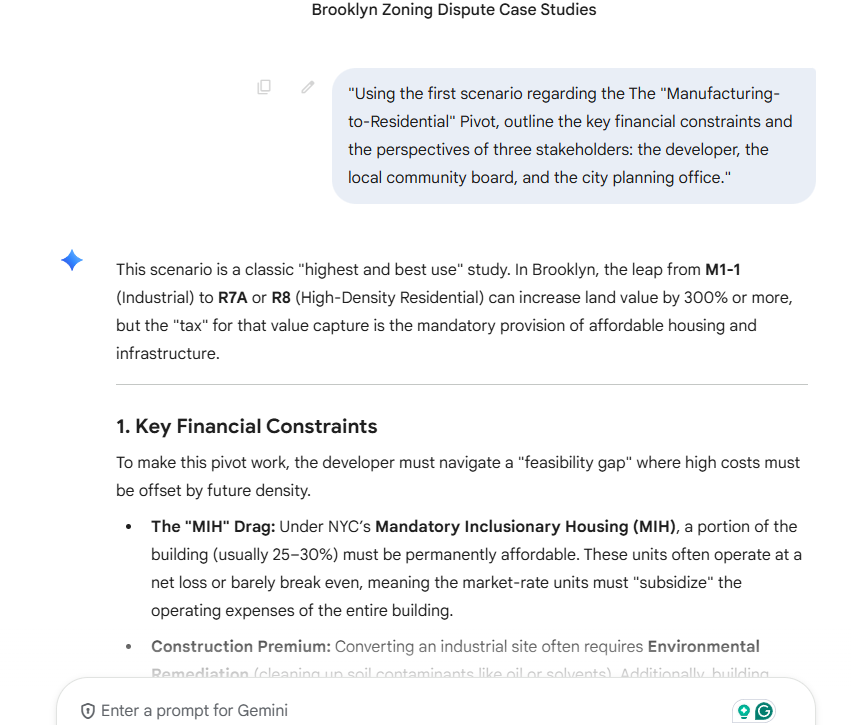

By "chaining" these steps, you stay in the driver’s seat. You get to evaluate each idea before moving to the next one, ensuring the final result actually meets your students' needs.
I encourage you to adapt and expand on this approach by experimenting with the chain's length, layering in more granular constraints (e.g., requiring the AI to adopt the persona of a skeptical city council member to test the feasibility of the developer's proposal), or applying this approach to other educational tasks such as lesson planning, assessment design, or administrative workflows to see how it can be tailored to your unique context.
Want to learn more? Stay tuned for my next post as I continue to share my takeaways and insights while working through the NYU Google AI for Education Accelerator program.
See our AI resources below (NYU log-in required):
Teaching and Learning with AI (Guides)
Introduction to Google Gemini (Workshop)
NotebookLM: An AI-Powered Study Tool (Workshop)
NYU Google AI for Education Accelerator (NYU IT Resource)
Google AI for Education Accelerator FAQ (NYU IT Resource)
Or contact us at nexus@nyu.edu for more information.
References
Google. (2026). Google AI Fundamentals [Online course]. Google Career Certificates. https://grow.google/ai-professional-certificate/


Comments