Print Your Dreams at the LaGuardia Studio

If you’ve ever wished you could explore an idea in three dimensions but didn’t know how to get started, you might be excited to learn that help is available right on the NYU campus. Located in a deceptively small building behind Bobst Library, NYU’s LaGuardia Studio offers the NYU community an incredible array of additive manufacturing services, including 3D scanning, 3D printing, and design help to make your vision a reality. The Nexus team recently toured their facility, and after seeing what the studio is capable of producing, I have a new appreciation for how far these 3D printing technologies have come.
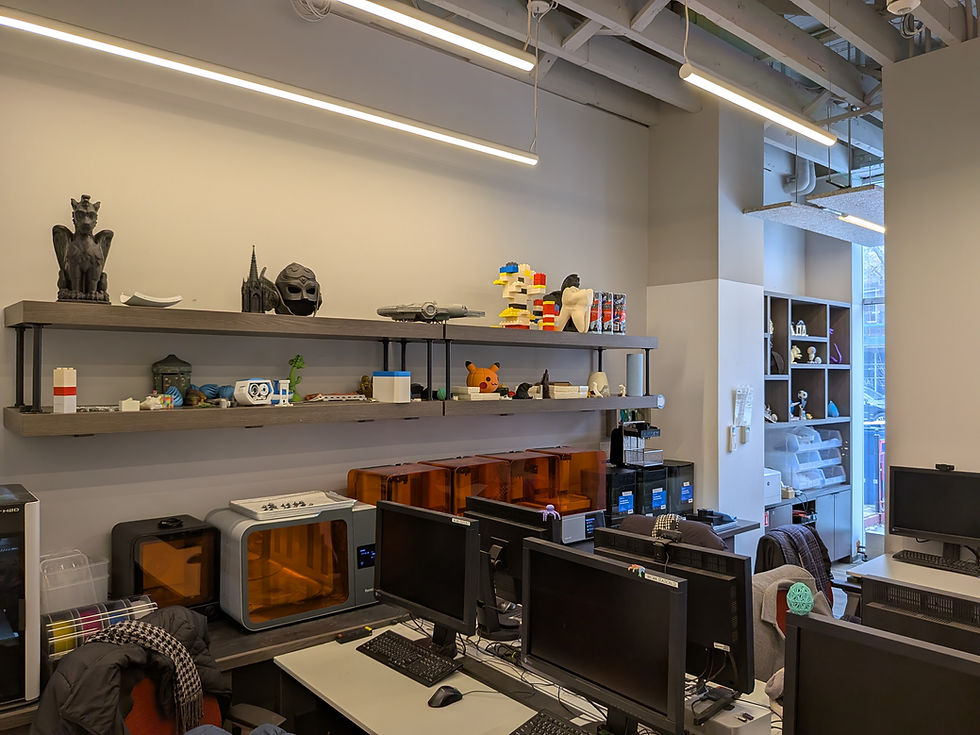
Like many buildings in New York City, the LaGuardia Studio is bigger on the inside than it appears to be from the street. Upon entering the studio, you find yourself in the self-service area, a room with a collection of computer workstations and small consumer grade 3D printers capable of printing in a variety of materials. The computers are loaded with 3D modeling software and are available for the NYU community to create and print models on their own. This little printing lab was delightful, but it turned out to be only the tip of the 3D iceberg.
Next to the self service area is the metals room, where printers print by melting layer after layer of metal powder with lasers. Before the tour, I didn’t know it was even possible to print with metal, so this was an unexpected revelation. We had the chance to hold and examine some of the items the studio has helped to produce, including artworks, mechanical parts, and a set of Megolodon teeth now visible in the Museum of Natural History. We also learned that it’s possible to print in a variety of metals, but that the size of the different powder particles limits the ones that can be printed in the current facility safely. In particular, titanium is highly sought after, but it requires an essentially bomb-proof room because the powder can be explosive!


After seeing the capabilities of the metals room, we went downstairs to the 3D scanning area. The LaGuardia Studio has multiple kinds of 3D scanners, capable of scanning objects of different sizes at different levels of detail. These can range from something large, like a person, at lower detail, to something much tinier, like a ring, at very fine detail. Scans can also be combined to add information in specific areas as needed. We learned that a top application of 3D scanning is for archaeology, allowing archaeologists to scan artifacts in other collections or in the field and then to bring the data back to be replicated as a print. Another incredible project the studio has done combines scanning and printing to replicate transplant donors in collaboration with NYU Langone. The studio continuously practices and hones their technique to improve their scanning abilities, with amazing results.

Finally, we moved on to the last section of the LaGuardia studio, which holds an array of larger 3D printers and associated machinery. Here, I admit I was too dazzled by looking at the sample prints to hear what they were made of, but what I can say is that they were either a) colorful, or b) squishy. (More details on the actual materials involved can be found on the LaGuardia Studio website.) Besides being very fun to hold and examine, these prints demonstrated a range of printing techniques with applications in medical and dental education, science, marketing, and even costume design. Some of the squishy ones, for example, had textures meant to replicate various kinds of diseased or healthy tissue. And the colorful ones showed an incredible variety of transparent, opaque, and gradient printing methods that were both precise and beautiful.

Having access to the printers and scanners at the LaGuardia Studio is very exciting, but it can be hard to know how best to take advantage of their capabilities. For this reason, the studio also offers design services, meaning they will work with you to figure out how to produce your project, from computer file all the way to physical print. By the end of our tour, the Nexus team was feeling a little dreamy and inspired, and one of my coworkers asked what the staff had studied in school to prepare them to do this work. The answer? Art. Almost every one of them has earned an MFA (Master’s of Fine Arts) and then has continued to build expertise by using the tools and experimenting with what they can do. And all of that craft and experience is available to the NYU community!


Comments